
Calvillo points to ‘fresh anointings’ among migrant communities facing hardship
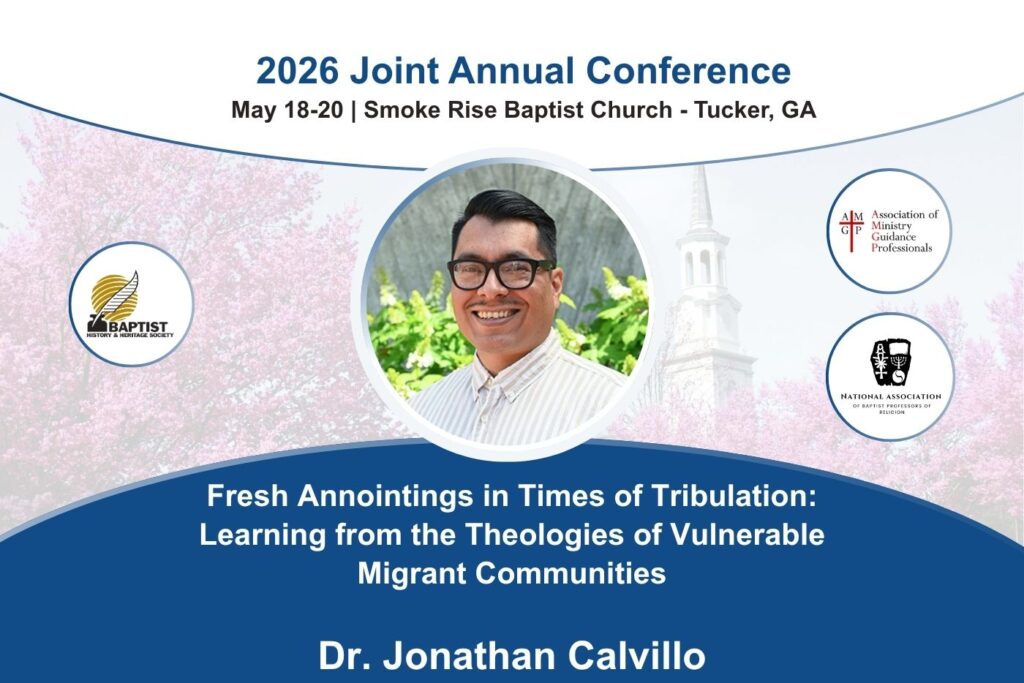
TUCKER, Ga. — “Something that gets lost in the process is we don’t often get to hear the voices of the very communities that are experiencing the most hardship in the midst of the situation,” Dr. Jonathan Calvillo told Baptist scholars, historians and ministry educators during the 2026 joint annual conference of the Baptist History & Heritage Society, the National Association of Baptist Professors of Religion and the Association of Ministry Guidance Professionals.
The May 18-20 joint gathering centered on the theme “The Church and Global Migration.”
Calvillo, associate professor of Latinx Communities at Candler School of Theology at Emory University, delivered the conference’s second plenary session May 19 at Smoke Rise Baptist Church in Tucker, Ga. His presentation, “Fresh Anointings in Times of Tribulation: Learning from the Theologies of Vulnerable Migrant Communities,” challenged attendees to treat immigrant communities not merely as people acted upon by policy, politics or religious institutions, but as communities actively interpreting their lives through faith.
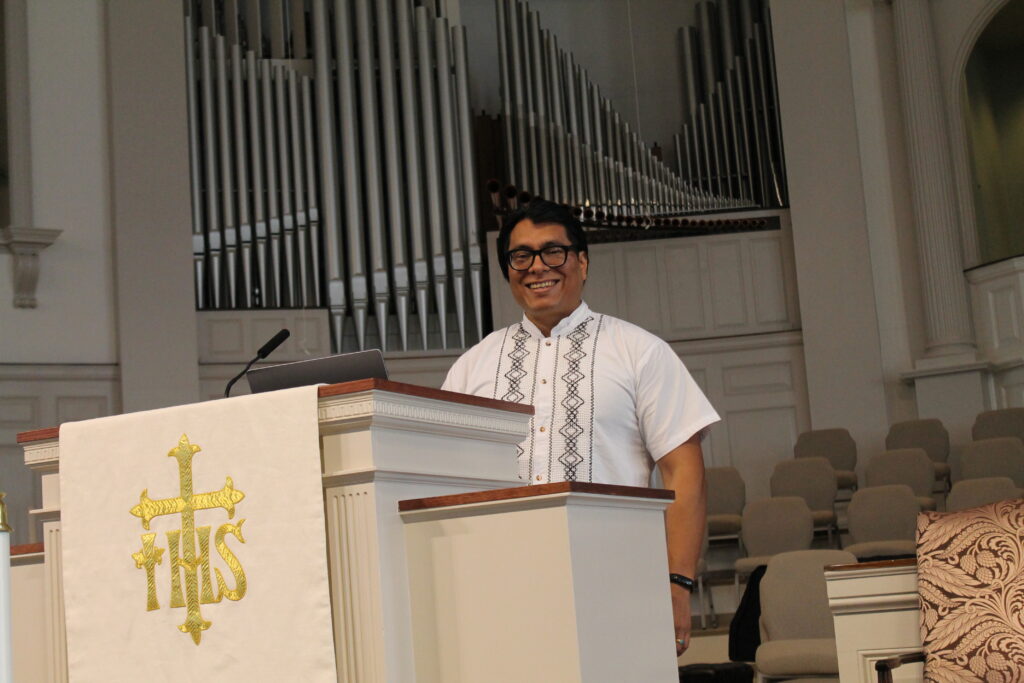
Calvillo said his aim was “for us to hear some of the voices of those in the community, those who are experiencing some of the challenges but are responding through faith.”
Born and raised in Southern California to Mexican American parents who immigrated from Mexico, Calvillo said his own family story shaped his interest in migration, faith and belonging. “In many ways our story is very much an immigrant story, but it’s also an all-American story,” he said.
He added that his family’s history reaches back generations in what is now Arizona, complicating simplistic narratives about borders and belonging. “These aren’t completely different worlds,” he said. “These are intertwined worlds and communities.”
Calvillo also described growing up in a Latino Pentecostal church where migration stories were often told as testimonies of divine protection and survival. “For them, migration was inseparable from their testimony,” he said.
That connection between migration and testimony framed much of Calvillo’s presentation. He argued that migration is not a marginal theme in Christian faith but central to how Scripture and Christian communities understand the people of God.
“Reading the scriptures through the lens of migration illuminates so much of the experience of the people of God,” he said.
Calvillo focused especially on Latino immigrant churches responding to intensified immigration enforcement in places such as Atlanta, Minneapolis and Los Angeles. He said public narratives often portray Latino evangelical churches as politically uniform or as complicit in current immigration policy.
But Calvillo urged a more careful reading.
“The most vulnerable are the ones that didn’t vote for this,” he said. “Is something else happening simultaneously? Is there a counter vision of political engagement that’s being enacted in these very communities that are being brutalized?”
That “counter vision,” Calvillo said, appears in sermons, prayers, testimonies, pastoral care, public witness and community organizing. He described these as “fresh anointings” in a time of tribulation — moments when “people are stepping into a call, stepping into a call to care, to show compassion, to accompany, to look after, to advocate for.”
One example came from the Atlanta area, where Calvillo discussed the case of Wilson Rogelio Velasquez Cruz, a Honduran immigrant detained by ICE outside his church building in Tucker after worshiping with his family and congregation. Calvillo said the incident sent shockwaves through immigrant church communities, many of which feared similar enforcement actions at or near places of worship.
In response, Calvillo said, pastors and congregants interpreted the moment theologically. Rather than seeing immigrant church members primarily through categories of legal status, he said, pastors were doing “the job of mending and healing, restoring, and offering dignity.”
He also emphasized the agency of migrants themselves. Referring to reports that Velasquez Cruz preached to other detainees after being detained, Calvillo said the story showed how “many migrants through their faith find ways to exercise their agency.”
“These are not folks that are just passive in their faith experience,” he said.
Calvillo also highlighted pastors who have connected the experiences of migrants to biblical narratives, including Joseph’s displacement and Jesus’ life as a refugee. He described one pastor whose “Christology is very much informed by this understanding of migration.”
The presentation also drew attention to women’s leadership in immigrant churches, especially in pastoral care, prayer and advocacy. Calvillo said that “if we only listen to the voices that are constantly getting the spotlight from the pulpit, we sometimes miss the extensive work that a lot of women are engaging in.”
Prayer, he said, has become one place where women leaders theologize in public and pastoral ways. “She talks about prayer in this case as a weapon, but really I also see it as a form of advocacy,” Calvillo said.
In some prayers, he said, women have asked God to protect vulnerable migrant workers by making them unseen to authorities. “They’re praying that God would make these vulnerable migrants invisible in the eyes of the authorities,” he said. “This is the reality that folks are living.”
Calvillo also pointed to testimony as a form of spiritual and social resistance. “Testimony becomes a form of pushing against the narratives that are out there,” he said.
Even when stories of detention, deportation or family separation do not end as congregations hope, Calvillo said immigrant Christians continue to interpret those experiences through faith. “Testimony and tribulation, they don’t always have the happy endings that they would hope,” he said, “but often these immigrants through their faith are able to make sense of what’s happening.”
Near the end of the presentation, Calvillo described growing solidarity among Latino, Black, LGBTQ-affirming, Jewish, Muslim and Catholic communities working together in support of immigrants.
“There’s been a tremendous move of solidarity across identities,” he said, calling it “this alternative community, this beloved community, presenting a different vision of what could be.”
For Calvillo, the question was not only what immigrant communities are doing, but whether others will recognize and join their witness.
“These Latino immigrants continue to draw strength from their faith,” he said. “They continue to defy what the circumstances seem to tell them and what the media seems to tell them.”
“This is where I believe Jesus moves in the borderlands, in that liminal space, in that unknown place of limbo,” Calvillo concluded. “So are we willing to walk with Jesus into these borderlands into the unknown?”
The joint annual conference included plenary sessions, paper presentations and organizational gatherings for BHHS, NABPR and AMGP. View photos from the 2026 Conference here.
Founded in 1938, the Baptist History & Heritage Society is a nonprofit organization with members worldwide, including Baptist scholars, clergy, laity, students and congregations. BHHS helps Baptists discover, conserve, assess and share their history, bridging the worlds of the academy and the congregation through publications, conferences, resources and seminars.
To learn more about the Society, become a member or support its work, visit www.thebhhs.org.
2026 Conference Recap
Calvillo points to ‘fresh anointings’ among migrant communities facing hardship’
Pablo Juarez urges Baptists to see migration through people, not politics
Rev. Dr. Melody Maxwell receives 2026 W. O. Carver Distinguished Service Award
Smoke Rise Baptist Church honored with Carolyn Blevins Meritorious Service Award
Ranmi Bae recognized with Norman W. Cox Award for Best Article
Kaufman pastor discusses immigration struggles (Baptist Standard)