
Pablo Juarez urges Baptists to see migration through people, not politics
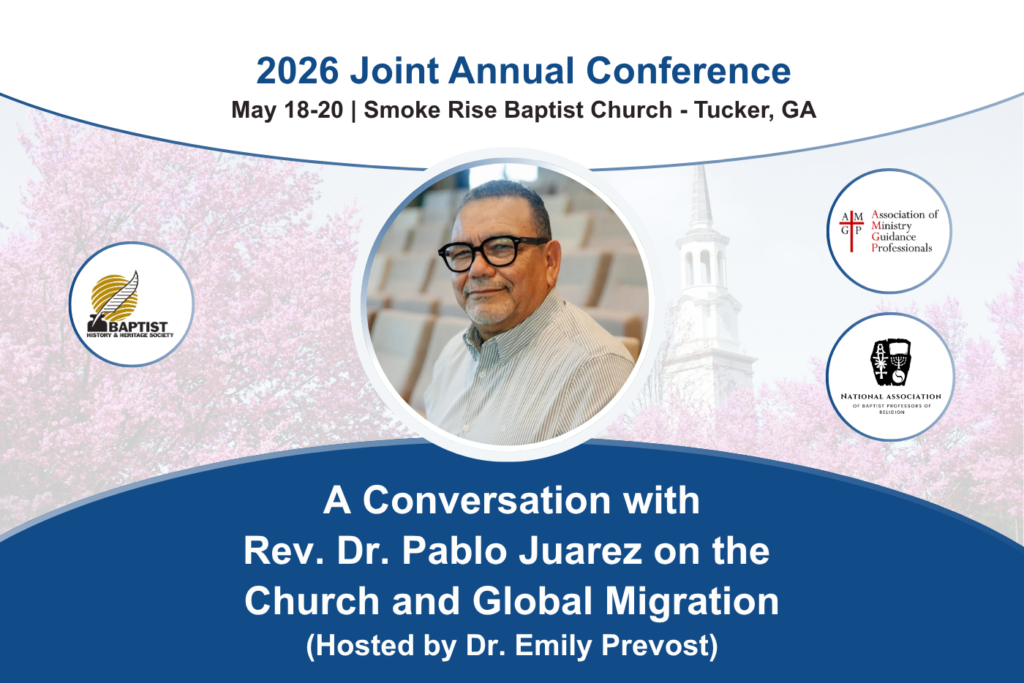
TUCKER, Ga. — “Immigrants are not numbers, not statistics,” Rev. Dr. Pablo Juarez told Baptist scholars, historians and ministry educators gathered at Smoke Rise Baptist Church. “They are human beings that are running for their life, begging for some people to take care of them. And it’s a tragedy if we don’t do that.”
Juarez, pastor of First Baptist Church en Español in Kaufman, Texas, made that appeal during the opening plenary of the 2026 Joint Annual Conference of the Baptist History & Heritage Society, the National Association of Baptist Professors of Religion and the Association of Ministry Guidance Professionals. The May 18-20 conference, held at Smoke Rise Baptist Church in Tucker, Ga., centered on the theme “The Church and Global Migration.”
In a conversation with Dr. Emily Prevost, professor at the University of Mary Hardin-Baylor, Juarez pressed participants to understand migration not as a distant political issue but as a pastoral and congregational reality already shaping churches across the country.

His message came from both personal experience and pastoral work. Born in Nicaragua, Juarez described growing up in poverty, being enrolled in the Sandinistas as a teenager, studying in Cuba and later living through war. When violence again threatened his family, his wife urged him to consider leaving.
“Now we have our children, we need to do something,” he recalled her saying. “We need to leave.”
That decision, Juarez said, is often misunderstood by those who have never faced it.
“Leaving our home country is one of the most painful decisions that we have to make,” he said. “Let me tell you, very painful leaving your fathers, your parents, leaving your siblings. And you don’t know that you going to see them again.”
“We don’t come here for fun,” he added. “Most people are running for their life and their children.”
After arriving in the United States, Juarez said his family faced language barriers, insecurity and disorientation. The turning point came through a congregation that helped him discover belonging.
“The church helped me to feel valued, to feel accepted, to feel that I was somebody,” he said. “And that changes my life.”
Now, as a pastor, Juarez said he sees immigrant families facing new waves of fear, instability and separation. He described receiving an early morning call from a woman in his congregation.
“Pastor, can you come, please?” she told him. “My husband has been taken by ICE.”
The congregation, Juarez said, often encounters the limits of what it can do.
“One of the things that we know [is] that we are powerless,” he said. “There is nothing we can do humanly speaking. And sadly, we know that there is nobody speaking for us.”
Yet those pressures also have changed the church.
“The church started getting more the togetherness and the fellowship and the compassion toward each other,” Juarez said. “That solidarity and the love and the compassion for each other, that’s something that been an awakening in my church.”
Juarez said the congregation has learned to respond with more than sympathy.
“Our church got united with the family, supporting the family,” he said. “Not just praying for them, but financially.”
For Juarez, that response is central to Christian witness.
“We are not in a crusade converting people from one religion to another,” he said, “but we are on a mission to show people how the love of Jesus looks like.”
Ken Gore, outgoing president of AMGP, said Juarez’s earlier writing helped prompt the invitation to address the conference. Gore quoted from a piece Juarez wrote for the Baptist Standard, in which Juarez said Christians must serve immigrant families “with faithfulness, compassion, and practical care while remaining grounded in the gospel of Jesus Christ.” Gore also cited Juarez’s conviction that “as a Christ ambassador it is more important to be spiritually correct than politically correct.”
Asked what churches and educators should pass on to future leaders, Juarez pointed to a simple but demanding foundation.
“The greatest thing that we can teach our students is very simple, it’s to love God and love people,” he said. “If they came out with the cross in one hand and the greatest commands in the other one, I think that’s all they need.”
Juarez also urged churches to practice dignity as a theological commitment, not merely a social courtesy.
“Dignity, being pro-dignity is a way that you can show love,” he said. “Every person [bears] the inherent image of God. And when we see God in people, we don’t have other option but to love, to care, and to protect.”
Prevost closed the session in prayer, asking that churches learn from “brothers and sisters who have faced insecurity, powerlessness, fear, and have stood together and learned to be the church for one another.”
She prayed, “May we not walk away from this evening and forget what we’ve heard.”
The joint annual conference included plenary sessions, paper presentations and organizational gatherings for BHHS, NABPR and AMGP. View photos from the 2026 Conference here.
Founded in 1938, the Baptist History & Heritage Society is a nonprofit organization with members worldwide, including Baptist scholars, clergy, laity, students and congregations. BHHS helps Baptists discover, conserve, assess and share their history, bridging the worlds of the academy and the congregation through publications, conferences, resources and seminars.
To learn more about the Society, become a member or support its work, visit www.thebhhs.org.
2026 Conference Recap
Calvillo points to ‘fresh anointings’ among migrant communities facing hardship’
Pablo Juarez urges Baptists to see migration through people, not politics
Rev. Dr. Melody Maxwell receives 2026 W. O. Carver Distinguished Service Award
Smoke Rise Baptist Church honored with Carolyn Blevins Meritorious Service Award
Ranmi Bae recognized with Norman W. Cox Award for Best Article
Kaufman pastor discusses immigration struggles (Baptist Standard)