
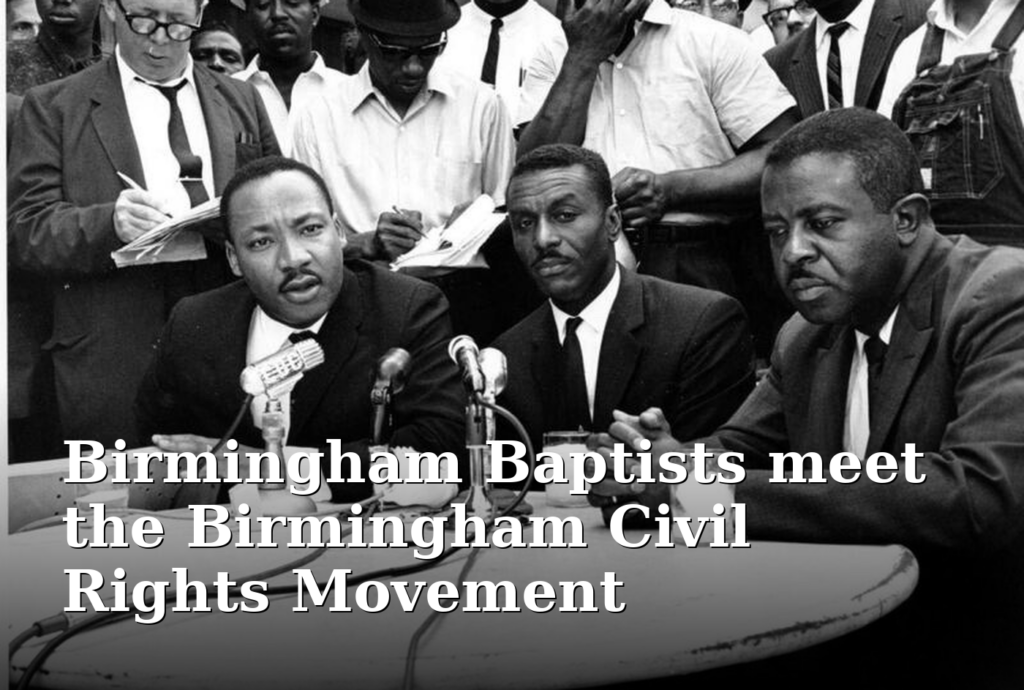
Birmingham Baptists Meet the Birmingham Civil Rights Movement
This article first appeared in the Summer 2022 (Vol. LVII, No. 2) issue of the Baptist History & Heritage journal. Subscribe to receive the BHH journal at www.thebhhs.org/membership.
By Dr. Andrew M. Manis
Andrew M. Manis is a retired professor of history at Middle Georgia State University in Macon, Georgia.
I was born in Birmingham and spent my childhood in Southside Birmingham. I was at Avondale
Park, playing Pony League baseball when the coach of our team—ironically called the Yankees—told me and the other thirteen- and fourteen-year-olds in his care that he “couldn’t understand why everyone was so worked up over just another dead n****r.”
The victim of that murder was Martin Luther King Jr. That was my first conversion. That was the day I realized that all the adults I knew were wrong about the issue of race and that Dr. King was right.
The Jesus Movement followed the Civil Rights Movement into Birmingham. I got caught up in it, experienced my second conversion, and became a follower of Jesus.
Sometime after that I was driving to my part-time job at Baskin Robbins when the radio blared out the news that a young black mother and her young daughter had tried to join the First Baptist Church of Birmingham and were turned away. A new convert with a not-quite-converted vocabulary, I exclaimed out loud, “Baptists! What the hell is wrong with these people?” Now if I had known how many times since then I would have reason to ask that question, I probably would have immediately looked for the nearest Methodist church.
Later I did become a Baptist, heard a call to the ministry, and headed for Samford University in my hometown. At Samford I first listened to King’s “I Have a Dream” speech and wept. I have spent most of my scholarly career writing about the civil rights movement in Birmingham. In fact, most of the historians who have written specifically about the 1963 Birmingham demonstrations are natives of this city.1
Conflict over race descended upon FBC Birmingham and continued throughout most of 1970. One would be hard put to find a white Baptist church throughout Alabama that did not experience some level of conflict over race in the late 1960s and 1970s.
Founded in 1871 around the iron ore deposits on what came to be known as Red Mountain, Birmingham was named after “the best workshop town in all England,” quickly becoming known for its steel production. As such the city eventually came to be known as the “Pittsburgh of the South” and, because of its rapid growth, “The Magic City.” Industrialists arrived bent on exploiting the black labor force, as Jim Crow descended on the post-Reconstruction South. The working-class nature of the city became fertile ground for the growth of the Ku Klux Klan, so that by the 1960s two more nicknames attached themselves to Birmingham—ironically, the “City of Churches” for white people and “Bombingham,” coined by African Americans in response to some fifty bombings of their homes between 1947 and 1965. Birmingham’s irony matched that of the entire South, which was known as both the “Bible Belt” and the “lynching belt.” The city also had become, through the auspices of Commissioner of Public Safety, Eugene T. “Bull” Connor, the most segregated city in America and the most committed to keeping it so.2 Having set the background in Birmingham, it is now time to meet the Birmingham Movement.
Meeting the Birmingham Movement
The popular view of Civil Rights in America visualizes a centralized, top-down movement with the Reverend Martin Luther King Jr. leading from Atlanta like General Eisenhower in command of Allied forces at Normandy. In reality, it was a series of indigenous local efforts led by local leaders in different places and times using different means to break the power of Jim Crow. Nowhere was this more the case than in Birmingham. To meet the movement that developed there is to be introduced to its unrivaled leader, the Reverend Fred Lee Shuttlesworth. Though sometimes viewed as an outgrowth of King’s work with the Montgomery Improvement Association, Shuttlesworth’s organization was of independent origin, and his civic work in Birmingham as pastor of the Bethel Baptist Church began in 1953, before King’s arrival in Montgomery. Nor was he ever one of King’s “lieutenants.”
Working with the local National Association for the Advancement of Colored People (NAACP) branch and “civic leagues,” Shuttlesworth sought to clean up black areas of Birmingham and reduce the influence of dives and “juke joints.” From these initial efforts, Shuttlesworth made his public debut petitioning the Birmingham City Commission to hire black police officers that would be charged to patrol black areas around these seedy establishments. Ignored out of hand by the City Commission, Shuttlesworth increased his efforts as Membership Chairman of the Birmingham Branch of the NAACP. 3
When the United States Supreme Court struck down school segregation in Brown v. Board of Education, Shuttlesworth received the ruling as another kind of conversion experience, later commenting: “The Supreme Court decision made me personally feel as if I was a man. I had the same rights, my kids had the same rights as other folks.”4 To discuss Shuttlesworth and his movement requires speaking of their pure, undiluted character in two important areas.
Shuttlesworth’s Undiluted Courage
In June 1956, after the state of Alabama issued an injunction against the NAACP, church members and other admirers implored Shuttlesworth to do something to counter the state’s repressive action. For days he meditated, prayed, and met with ministerial friends discussing what might be done, until his sleep was interrupted by a voice calling him to form an organization to take the place of the NAACP.
After another few days of planning, Shuttlesworth called a citywide meeting on June 5, 1956, to vote on forming an organization that was eventually named the Alabama Christian Movement for Human Rights (ACMHR). Older ministers cautioned against hasty action. The Reverend Luke Beard, pastor of the Sixteenth Street Baptist Church, said that God had told him to tell Shuttlesworth not to proceed with this new organization.
Shuttlesworth retorted, “Since when did God start sending my messages through you?” Denouncing gradualism, Shuttlesworth told the audience, “We want a beginning NOW. We have already waited 100 years.” Over the next ten years, the ACMHR would be the organizational extension of Fred Shuttlesworth’s fervor to end segregation, not only in Birmingham, but also throughout the entire nation.5
Immediately after the December 6, 1956, Supreme Court ruling ending segregated bus seating in Montgomery, Shuttlesworth quipped, “Well, if it’s unconstitutional in Montgomery, it must also be unconstitutional in Birmingham.” Shuttlesworth decided to press the issue in Birmingham immediately. He sent a telegram to the City Commission indicating that the ACMHR now considered all laws segregating seating on buses throughout the state of Alabama to be null and void. He also requested that bus seating be desegregated by December 26. Such an action, he averred, would convince African Americans that “Birmingham is in line with the truly democratic process and shall insure that we are truly becoming a brotherhood.”6
No one in the white community took Shuttlesworth’s threat seriously. Worship services came and went on Christmas Day. That evening, the Shuttlesworth family was spending Christmas Night showing off gifts with the family of Deacon Charlie Robinson. A few minutes after 9:30 p.m., Shuttlesworth’s daughter Ricky thought she heard a thud coming from the front corner of the house, literally one foot adjacent to the church. Then came a blast that blew out the power, crushed the front corner of the home just below where Shuttlesworth was reclining while discussing movement matters with his deacon. In the crawl space beneath the wood floor just beneath the bed on which the preacher lay, sixteen sticks of dynamite were detonated with intent to kill or at least scare the victims out of town.
As the neighbors gathered around the house and the dust settled, and after Shuttlesworth found his pants in the dark, he emerged from the blast with only a minor scratch on the head. Noticing some in the crowd carrying guns, he preached a sermon to them on nonviolence to calm things down. When a police officer advised Shuttlesworth to skedaddle out of town, the minister replied, “You go tell your Klan brethren that the war is on and I’m here for the duration. The Klan wrote my name on the bomb,” he asserted, “but God erased it off. God saved me to lead the fight.” One of the young members of the Bethel Church later said: “If we had seen Jesus walk on water, we wouldn’t have been any more reverent than we were when we saw Shuttlesworth come out of that house alive.”7
Internally, Shuttlesworth experienced what William James called a “noetic experience.” He later testified: “I understood in a moment that I wouldn’t get hurt.” Without an audible sound, Shuttlesworth “heard” the words of Scripture, “Underneath [you] are the everlasting arms” (Deut. 33:27). He immediately intuited “that the words were factual” and that God’s presence would protect him from harm.
Describing the experience later, he said, “You can know something in a second that you never read in a book nor ever will. You can feel something in a second that will be with you [for] the rest of your life.” He also instantly connected his survival with his participation in the civil rights struggle: “I knew in a second, [a] split second, that the only reason God saved me was to lead the fight.”8
This and two later bombings of Bethel Baptist Church underscore how this experience provided the preacher and his following the certainty that God was behind his actions. In a later conversation with Shuttlesworth, Martin Luther King Jr. said that if surviving the bomb “wasn’t God making himself plain, there’s no way he can.” Shuttlesworth agreed: “Well, God just brought the Bible up to date. You don’t have to go back to Daniel in the lion’s den or the boys in the fiery furnace.”9
Years earlier, while riding on a train to Oklahoma City, Shuttlesworth, troubled by conflict with his deacons at First Baptist Church, Selma, Alabama, had prayed “God, fix me so I won’t worry so much.”10 Perhaps never in the history of Christianity had God more completely answered a prayer in the affirmative. Surviving the bombing was indeed God’s “fixing” of Fred Shuttlesworth. Finally, he assured the bystanders that the bomb had only poured gasoline on the fire of protest in him and that plans to ride the buses would not change. “We intend to ride the buses. There is no one who can keep us from it.” Despite the bombing the night before, he and a hundred followers took seats in the front of Birmingham buses on December 26, with twenty-two arrested.11
Shuttlesworth began to attack Birmingham’s segregation laws “on every front.” That he was not killed as a martyr to the cause of racial justice was not for lack of trying. Later, he often told audiences, “I tried to get killed in Birmingham.” His challenge to white supremacy caused the less committed to wonder about his sanity. This willingness to die for the cause, coupled with his seeking out opportunities to “kill segregation or be killed by it,” led Andrew Young to call him, “the most admired leader of the movement, but also the most avoided.”12 He was like an action hero in movies who is constantly shot at, but only by not-so-sharp-shooters. For this reason his followers came to believe he was invincible because God’s protective hand was upon him.
Consider this prominent example of courage in the face of danger. In September 1957 Shuttlesworth announced to the press and Birmingham’s Superintendent of Schools that he would be enrolling his daughters in the all-white Phillips High School on the first day of the fall semester. A week before the announced date, Klansmen captured, pistol-whipped, and nearly castrated a young black man named Judge Aaron. They told him that the same treatment awaited blacks who tried to integrate the schools. There was little question that Shuttlesworth was the intended recipient of the message as he was the only one attempting to integrate Birmingham’s schools at that time.
Despite this credible threat, on the day itself, Shuttlesworth descended into his own fiery furnace. As he approached the school, his car was met by a mob of 15–20 assailants who beat the preacher with bats, bicycle chains, and brass knuckles. The next day the beating was depicted on page one of the New York Times, but because the event occurred on the same day as other dramatic events surrounding the desegregation of Little Rock’s Central High School, it did not receive the national attention it otherwise might have. In the aftermath of the beating, Shuttlesworth the pastor said, “This is the price one pays for freedom.” The pastor’s wife Ruby, who had been stabbed in the buttock during the melee, said her only regret was that modesty would not permit her to show off her scar at the next mass meeting!13
Though often arousing his supporters at church or mass meetings with the unpolished rhetoric of the black folk pulpit, he primarily appealed to them through daring acts of defiance against his principal antagonist, “Bull” Connor. His actions inspired the courage and confidence of ordinary blacks who loved and adored him. In blunt, unembellished terms, the raw emotionality of his expression captured their feelings in ways that even King sometimes did not.
More importantly, however, his bold confrontations fundamentally embodied the feelings of poor and working-class blacks. Longtime friend James Armstrong compared Shuttlesworth to King, noting: “Now Martin knew how to say it; [But] Fred knows how to do it… I’ve had good preachers to preach to me, but Fred has preached to me in action.”14
Such actions suggested that what was needed among Birmingham’s blacks was a leader who, as one Birmingham minister put it, “couldn’t lose nothing but his life.” Shuttlesworth inspired and galvanized support for the struggle in Birmingham and the South by his almost legendary willingness, even eagerness, to sacrifice his life in reckless defiance of Jim Crow. For this reason Martin Luther King Jr. called him “one of the nation’s most courageous freedom fighters,” a testimonial echoed by virtually all veterans of the civil rights movement.15
Some years ago, the film Glory told the story of the 54th Massachusetts Infantry, the first black regiment in the Civil War. The night before their suicidal attack on the Confederate Fort Wagner, the film shows the soldiers in a religious testimony meeting. At a climactic point the character played by Morgan Freeman tells his comrades, “If tomorrow is that great gettin’ up mornin’, then let’s let our loved ones know we went down standing up.” Historian Gerald Linderman described the experience of Civil War soldiers as “embattled courage.”16
Fred Shuttlesworth displayed an embattled courage—pure and undiluted—one that made him willing to “go down standing up” for justice and freedom. If we Americans patriotically celebrate and mark as sacred the places where such sacrifices were made to defend freedom on foreign shores, it is more than appropriate that we celebrate and mark as sacred the places, like Bethel Baptist Church, bombed three times in a struggle to extend freedom on our own streets.
Undiluted African American Spirituality
First, what began in the parsonage of the Bethel Baptist Church and spread to many other churches showed the undiluted blackness of the Birmingham movement and its leader. It has been in scholarly vogue over the past fifteen or twenty years to emphasize the black or African American roots of the civil rights movement and to de-emphasize white contributions to the movement. For the most part this historiographical emphasis has been right and proper. Many early scholars have sought to note the role of Gandhian nonviolence in the movement, but as one black preacher told me, “When Martin marched, they weren’t singing no Indian songs. They were singing black spirituals and it was out of that context that he preached.”
In addition, the respective preaching styles of King and Shuttlesworth suggest a significant difference. Shuttlesworth’s homiletical approach originated with the black folk pulpit and did not borrow heavily from white princes of the pulpit such as Harry Emerson Fosdick, George Buttrick or J. Wallace Hamilton as did King’s.” He was much less likely than King to write out his sermons, either in outline or in full manuscripts. Perhaps most significantly, Shuttlesworth was more likely to engage in what some consider a hallmark of black preaching, the “whoop.”17
Scholars like James Cone have rightly argued King’s preaching was more “black” when he spoke to exclusively black audiences. In fact, Lawrence Edward Carter Sr., dean of the Martin Luther King International Chapel at Morehouse College, has indicated that many African American ministers saw King as a good “intellectual preacher” but not in the same homiletical league with “whoopers” like National Baptist Convention President J.H. Jackson or Aretha’s daddy, the Reverend C.L. Franklin.18
King expressed his reaction against the black church in a paper written at Crozer Theological Seminary, “An Autobiography of Religious Development.” In a later interview he said: “I had doubt that religion was intellectually respectable. I revolted against the emotionalism of Negro religion, the shouting and the stomping. I didn’t understand it and it embarrassed me.” 19
By contrast, some of Shuttlesworth’s early parishioners felt that he ran into conflict at First Baptist Church Selma in part because of his penchant for “country preaching” or “whooping,” which several of his sophisticated middle-class members disliked. For these reasons one may fairly argue that in Fred Shuttlesworth and his followers can be seen the undiluted African American character of the Birmingham movement.20
An incident typifying not only Fred Shuttlesworth’s role in Birmingham’s civil rights struggles, but in many ways his life and ministry, occurred at a mass meeting one Monday night in 1959. For several consecutive weeks the Birmingham Fire Department had served as the city’s instrument of harassment and intimidation, regularly interrupting ACMHR mass meetings. On this occasion, again, the wail of sirens drowned out the voices from the pulpit of the St. James Baptist Church.
Moments later, firefighters rushed into the church sanctuary wielding hoses and axes, ostensibly searching for a fire. Shuttlesworth asked the firefighters, “Gentlemen, what are you looking for?” Apprising Shuttlesworth that he had received a “report” of a fire in the building, the fire chief asked Shuttlesworth to clear the aisle of people.
Suspecting that the real purpose of the fire department’s arrival lay in stampeding the meeting, and exasperated by the repeated interruptions, an agitated Shuttlesworth replied, “Now Chief, we’re just tired as hell of ‘Bull’ Connor harassing us and we are about ready to just all of us go to jail. If Bull’s got room enough to arrest all the thousands of us, okay. We are just tired! We are not going to move!” The chief pleaded with the preacher, “This is no trick, Reverend,” beginning an explanation of the operative fire codes.
Knowing he would eventually be forced to give in, but wishing to encourage his onlooking followers, Shuttlesworth used the situation to fullest advantage. “Chief,” he demanded, “Can you assure me that this isn’t ‘Bull’ Connor harassing us? Because if this is ‘Bull,’ we are staying! You will have to drag us out!” Receiving the chief’s promise, the leader ordered the meeting moved to another church a few blocks away. Before leaving the premises, however, Shuttlesworth got in one last zinger: “Y’all think it’s a fire in here? You know there ain’t no fire here. The kind of fire we have in here, you can’t put out with hoses and axes!”21
Perhaps there was no fire in St. James Baptist Church that night, but in Fred Shuttlesworth there burned a fire that persisted throughout a lifetime of ministry to African Americans, both in the church and in the streets. As he moved from anonymity as a young pastor to national notoriety as a civil rights leader and finally to status as an icon of the movement, “a fire you can’t put out,” had burned in him brightly.
Theologian James H. Evans Jr. recently wrote of the “heavenly fire” of black Christianity. Similarly, social critic Cornel West drew attention to what he calls a “combative spirituality,” by which he means an eager, joyful spirituality that preserves meaning by fighting against claims of inferiority. West says that this combative spirituality is a subversive joy that amid political struggle transforms tears into laughter. “Fiery glad” instead of “fiery mad,” this distinctively African American spirituality looks disappointment and despair and death in the face and declares that beyond all these there is hope. Fred Shuttlesworth embodied in undiluted fashion both these elements—“heavenly fire” and “combative spirituality.”
Perhaps more than anyone in the entire civil rights movement, Shuttlesworth incarnated the fiery “combative spirituality” at the heart of African American religion. The fire hoses of 1963, which never unloaded a drop of water on King or Abernathy, slammed Shuttlesworth against the side of the Sixteenth Street Baptist Church and bruised his ribs. But they never extinguished “the fire you can’t put out.”22
Shuttlesworth’s combustible persona burned hot against those forces he saw as enemies of righteousness and justice, attracting true believers to its flame. His life reveals in very clear form something about the nature of African American religion. Yet, in 1993, NBC Dateline aired an entire program dedicated to commemorating the thirtieth anniversary of the Birmingham Demonstrations. The transcript is eighteen and a half pages long, but contains zero mentions of Fred Shuttlesworth’s contributions to the movement over seven years.
In 1992, Benno Schmidt, the former president of Yale University, made a speech to the National Press Club. In the Q & A period that followed, he made an offhand reference to “Bull” Connor. He could invoke Connor’s name without feeling the need to identify him, while the name of the drama’s chief protagonist has dropped from America’s historical consciousness. That may be the best reason of all to attend to his story.23
Prelude to Project C (Confrontation)
In 2017 Clayborne Carson, arguably the preeminent King scholar in the world, gave a lecture at Brigham Young University posing the question: “What would it feel like if your career peaked at age 27?” For most of the six-year period between the end of the Montgomery Bus Boycott, Carson suggested, and the beginning of the Birmingham campaign, King’s successes were very minor. It looked like he had peaked at 27, at the end of the bus boycott.
After that, everything King and the SCLC tried yielded something in between mediocre success and dismal failure. Other civil rights groups were getting the headlines and leading the movement. King was a halting leader in 1961, refusing the pleas of the Freedom Riders to join them on the bus ride from Birmingham to Montgomery. The 1962 campaign in Albany, Georgia, was an abject failure. Movement people wondered if King was sinking into obscurity.
Meanwhile, by April 1959, activist Anne Braden, a reporter for the radical newspaper the Southern Patriot, collaborated with Shuttlesworth to produce a publicity pamphlet called “They Challenge Segregation at Its Core.” Telling the story of Shuttlesworth and the ACMHR during its first three years, the pamphlet underscored the national importance of Shuttlesworth’s work in Birmingham:
If you believe in human dignity and brotherhood, Birmingham Negroes are fighting your battle. Birmingham is the strongest bastion of segregation in America. When equality and right win there, the key line of segregationist defense will be breached. From then on, victory for human rights will be easier everywhere. Birmingham in a sense is the test for America’s future.24
By April, 1959, Shuttlesworth began insisting on more action by SCLC, writing pointed letters to King complaining that he was not attacking segregation vigorously enough. He saw civil rights leadership in Alabama as “much less dynamic and imaginative than it ought to be.”
He continued, “When the flowery speeches have been made, we still have the hard job of getting down and helping people…[the SCLC] must move now, or else [be] hard put, in the not-too-distant future, to justify our existence.” Looking forward to a forthcoming SCLC board meeting, he hoped that “we can really lay some positive plans for action… Now is the time for serious thinking and practical resulting actions.”
In June, Shuttlesworth wrote another impatient letter to King reiterating his call for action. “I had certainly expected to hear from you further on this matter before this time…It is my feeling that the times are far too critical for us to get good solid ideas on what should be done in certain situations, and then take too long a time to put these ideas into action.”25
In 1961 Shuttlesworth was the primary contact person in Alabama for the Freedom Rides. He sent some of his followers to retrieve them when one bus was burned in Anniston. When the other busload was beaten in Birmingham, Shuttlesworth’s family and church members bandaged their wounds and housed them. In 1962 Shuttlesworth and Rev. Charles Billups were jailed for activities related to the Freedom Rides, remaining incarcerated for thirty-six days. In the fall of that year, as the failed Albany Campaign ground to a halt, Shuttlesworth called on King to hold the annual SCLC Convention in Birmingham and to threaten massive demonstrations. With that threat, merchants removed segregation signs from downtown department stores—but only temporarily. The return of those signs set the stage for Project C (Confrontation) in the spring of 1963.
Finally, by January 1963, King relented and committed to a major campaign in Birmingham for three reasons: first, he was desperately in need of a big victory. Second, Shuttlesworth and his organization had virtually pestered King into it. Shuttlesworth not only invited King to come to the city, he insisted, even demanded that King finally join with his ACMHR to challenge segregation in segregation’s strongest bastion. Third, King also committed the SCLC to Birmingham because of a nucleus of available demonstrators Shuttlesworth had developed over the previous seven years. Wyatt T. Walker argued the point forcefully:
I’m absolutely convinced without any reservation, [the] Birmingham [protests] never would have been without a Fred Shuttlesworth. You could not have come to Birmingham if there hadn’t been a Fred Shuttlesworth there. He was not just a preacher in Birmingham with some people who were interested in human rights. It was the very nature of his persona—his doggedness, his tenacity, his courage, his craziness. I mean all of that congealed to make Birmingham fertile for what we needed to do.26
Thus, Shuttlesworth laid the groundwork for and made possible the 1963 demonstrations, which in turn yielded introduction of what eventually became the 1964 Civil Rights Act, federal legislation ending segregation in public accommodations in America. Those demonstrations also laid the groundwork for Selma, which in turn made possible the 1965 Voting Rights Act.
Indeed, even King lieutenant Andrew Young has said on at least two occasions that Fred Shuttlesworth “saved the civil rights movement.”27 Diane McWhorter called Birmingham “the climactic battle of the civil rights revolution,” while African American Baptist minister in Lynchburg, Virginia, Virgil A. Wood, who was very active in the national NAACP, called Birmingham “the hinge” of the movement. Glenn T. Eskew underscored Birmingham’s national importance by borrowing the words of President Kennedy for his title, But for Birmingham, implying that without Birmingham, and without Fred Shuttlesworth, the Civil Rights Act of 1964 would have remained a legislative impossibility.
In short, Fred Shuttlesworth and the Birmingham protests by the ACMHR and SCLC were collectively the crucial turning point of the movement because they gave the movement what was perceived as an unqualified victory when it needed one most.28
White Birmingham Baptists and the Movement
Once racial segregation became the norm in the 1890s, both in practice and in law, most white Baptists (and non-Baptists as well) “could hardly remember a time when Christians of both races routinely worshiped together.” That African Americans were created as a separate and inferior race, that black worship consisted of heathenish revelries, that black preachers were unequipped to lead their flocks, and that black churches might become dangerous centers for political organizing were all, argued Paul Harvey, “fundamental articles of faith held by nearly all white southern Christians after 1865.” 29
By the 1950s, white southern devotion to segregation was weakening. Lynching was losing its previously unassailable hold over white Methodists, thanks to Jessie Daniel Ames, Dorothy Tilly, and the Southern Women for the Prevention of Lynching.30 America’s participation in World War II—a war against the Nazi ideology of a “super race”—created the logical dilemma of fighting racism in Berlin and Nuremberg while ignoring it in Birmingham and Nashville. The Cold War struggle against the Soviet Union often pointed out American hypocrisy as a way of winning the non-aligned countries into the Communist bloc. Winning “hearts and minds” was key to prevailing in the Cold War. Both these strategies had modest success, preparing the ground outside the South for a crusade to end segregation.
Birmingham Reactions to the Brown (1954) Desegregation Ruling
When the Supreme Court ruled against school segregation in Brown v. Board of Education, Topeka, Kansas, much of the country was more amenable to racial change despite some ominous rumblings from the white South. Most shapers of public opinion counseled patience and calm. White citizens in Jefferson County perpetrated twenty-nine lynchings between 1934 and 1940.31
According to a poll in Newsweek, only 29 percent of white southerners supported desegregation at the time of the article.32 The Southern Baptist response was predictable, although the SBC advised its members to stay calm and act in a patient, Christian manner. Mark Newman summed up the response succinctly and accurately:
The SBC and Baptist State conventions, with rare exceptions, did not follow southern white segregationist sentiment during the civil rights struggle. But they could not afford to get too far in front of their coreligionists. Of necessity, they tended to hedge on segregation, even as they sought to persuade Baptists to accept the inevitability of its demise.33
The Alabama Baptist Convention Social Service Commission reprinted the SBC’s resolution on Brown, calling on Alabama Baptists to work out the crisis “in a spirit of Christ to the best interest of both races.” Yet prominent Birmingham pastor John H. Buchanan, pastor of the influential Southside Baptist Church publicly criticized Brown, complaining that it “complicates and damages relations between the races in the South. The present court from its cloistered chambers has overlooked the reality of the situation. Our people must exercise sober and sound judgment in facing this crisis.”34
After the failed attempt of Autherine Lucy to desegregate the University of Alabama in 1956 and during the ongoing Montgomery bus boycott, the Alabama Baptist state convention endorsed public school segregation although it did not support massive resistance and condemned an amendment to the Alabama constitution that authorized the abolition of public education. Opposition to desegregation decreased as the movement proceeded, dropping from 61 percent in 1963 to 16 percent in 1970. Yet the biblical defense of segregation, using many of the same arguments previously used to defend slavery, continued to be used into the early 1970s.35
Birmingham Responses to Shuttlesworth and King
Baptists in Alabama, along with the secular newspapers, almost completely ignored Fred Shuttlesworth’s efforts in Birmingham, most likely because he disproved the ubiquitous claim of segregationists that protesters were “outside agitators.”
Stories about Shuttlesworth’s activities were typically buried in the back pages of the Birmingham dailies, and Baptist literature never mentioned him. Shuttlesworth told me that he got no support, no help whatsoever, from any white minister, not even to denounce the two bombings of his Bethel Baptist Church.36
Shuttlesworth overstated this claim: Lamar Weaver, a unionist and lay minister offered his help when Shuttlesworth and his wife, Ruby, tried to integrate Terminal Station in 1957. Lutheran pastor Joseph Ellwanger joined in the 1963 protests in Birmingham and Selma in 1965, but Shuttlesworth was apparently unaware of it.
By contrast, Martin Luther King Jr. was denounced in pulpit and newspaper throughout the state, especially in letters to the editor. “Liberal,” “Socialist,” “Communist,” “troublemaker,” and “rabble-rouser” were the epithets Baptists in Alabama most often leveled at him—at least in public.
In 1961, after Southern Baptist Seminary invited King to speak in its chapel, the seminary was avalanched with criticism and thirty-five Alabama churches voted to cut off financial contributions to the seminary. Leon Macon, editor of the Alabama Baptist, told of traveling throughout the state trying to cool tempers and not meeting even one integrationist among Alabama Baptists. Hysterical fears of mongrelization continued, along with predictions that the end of segregation would “lower the moral conduct of whites to that of blacks.”37
Historian Wayne Flynt astutely observed that, just as white Baptist defenses of slavery in the nineteenth century sought to defend southern civilization against secular, humanistic, liberal, and corrupt mongrelization, the same could be said of twentieth century defenses of segregation. These beliefs made the battle harder, longer, and bloodier than it otherwise would have been.38
Birmingham Demonstrations and the “Letter from Birmingham Jail”
Most whites in Birmingham were aghast at the major protests in the spring of 1963, which finally joined the forces of King’s SCLC and Shuttlesworth’s ACMHR against Birmingham’s commitment to segregation, symbolized by the segregationist police state created by “Bull” Connor. Billy Graham publicly called on King to “put the brakes on a little,” but received little criticism.39 The eight white clergy who issued a “Good Friday Statement” on April 12 would have hoped for a similar response.40 It was not to be.
Several letters to the editor in the local newspapers praised the efforts of the white ministers. One writer believed the church leaders and other men of Goodwill had remained silent too long—racists had seized the day and were leading citizens down the “back alley of hate and violence.” The writer called on all ministers to follow the clergymen’s example and “cast off timidity and fear and lead citizens along the paths of good will.”41
On the other hand, the segregationist backlash came quickly. One wrote, “Are those gentlemen of the cloth so ignorant of the teachings of Holy Writ? That they want us to peacefully submit to integration, contrary to God’s instructions?” Another segregationist wrote, “Do they ask that we obey man rather than God?… To prevent integration is better for a country than integration, with its widespread lawlessness.” Birmingham lawyer Maurice Rogers wrote to each of the clergy and branded their statement disgusting, cowardly, ill advised, and inappropriate.
The eleven “hypocrites and conformists” needed to keep their mouths shut and stop meddling in race relations. After all, he concluded, George Wallace was America’s last hope to maintain freedom. “If you have any convictions, which apparently you have not, then you should stand in your own pulpits and preach it and not hunt up others whose religious views you despise to sign edicts with you. The truth is, your socialist statements have no part in your religion and no basis in your various doctrines…” Another asserted: “The day I have to go in church and have to smell stinking n****rs, that’s the day I’ll stay away and take a chance on my hopes of heaven.”42
Fred Shuttlesworth dismissed the clergy’s stand as nothing more than a “pebble in the ocean” of racial justice. “They ought to have started [speaking out] a long time before. Way on back, when they were beating, and castrating, and bombing, there should have been voices then…” He added that if the eight clergy had been on the “right side” of the integration issue, they would have boldly “marched with the people” in the streets of Birmingham. Although he knew none of these men personally, Shuttlesworth compared the eight clergy and their public statements to the New Testament Pharisees grandstanding before the public and judging from “high ecclesiastical and Pontifical positions.”
He complained that the white ministers had “never prayed for the people involved in the movement. Had they prayed or revealed any concern and love, they would have actively participated in the movement. They never spoke to us, they never encouraged me. They never prayed for me as a minister or brother. They never even spoke to me about what I was doing. They left me to the Klan.”43
Five months after the end of the Birmingham demonstrations, and four months after President Kennedy appeared on national television to address the race issue “in Birmingham and elsewhere,” the city prepared itself for beginning the process of desegregating its public schools. Nearly every adult in Jefferson County worried about possible violence, but no one ever imagined the bombing of Sixteenth Street Baptist Church and the deaths of four young girls as they transitioned from Sunday School to the worship service. Three of the girls’ funerals were conducted together on September 20.
Catholic bishop Joseph Durick invited clergy from across the city to attend the funeral at the Sixth Avenue Baptist Church on Southside. The eight ministers joined another 800 other religious leaders at the funeral—the largest interracial gathering in the history of Birmingham up to then. The Reverend John Porter, pastor of the Sixth Avenue Church, felt “great joy in seeing the togetherness of the religious community,” but also “great sadness that it took this event to bring us together.44
Birmingham’s Welcoming Pastors and the Travail of First Baptist Church
Among the eight clergymen who wrote to King, representing Southern Baptists was the Reverend Earl Stallings, senior minister at Birmingham’s First Baptist Church. As part of the ministerial contingent that publicly addressed the 1963 racial demonstrations, Stallings became one of the prime targets of hostile segregationists, both outside and inside his own congregation. An avalanche of criticism overwhelmed him, especially after he was photographed greeting black visitors to the Easter morning worship service on Sunday, April 14, 1963.
Newspapers across the nation, including the New York Times, carried the photograph, multiplying the hate mail and threatening phone calls that Stallings and his family endured. The congregation had already adopted an open-door policy regarding African American worshipers, but Stallings defended the policy in the face of segregationist members who were eager to change it after blacks continued to visit the church for several weeks thereafter.
Stallings’ mail included commendations for his commitment to the open-door policy, including from Martin Luther King, who praised him by name in his Letter from Birmingham Jail. Praise from King hardly helped his case with the segregationist members who demanded either a change of policy or a change of pastors.
They denounced the black visitors, whom they claimed did not attend worship services with sincerity but rather to advance their cause. They did not recognize that human motivations are always mixed and neglected to criticize the many who come to church more to enhance their businesses than to nurture their souls. On one occasion one of the segregationist members opined that the most “Christ-like way to deal with the situation, was to drive out these groups, just as Christ had expelled the ‘moneychangers from the temple.’”45
As the controversy continued, Stallings held his ground as the vicious criticism mounted. In one sermon he publicly blamed Birmingham’s white churches for much of the climate of unrest in the city. By choosing to remain silent in the wake of increasing violence, he asserted, the white churches had now become part of the racial problem. He also criticized the African American community for “submitting to . . . irresponsible leadership,” presumably Shuttlesworth and King. Segregationist members formed a coalition with fundamentalist members who rejected what they saw as Stallings’ socialist and unbiblical beliefs.46
The beleaguered pastor’s sermons were often greeted with clenched fists, gritted teeth, and heads shaking “no.” In May 1963 the congregation voted by a narrow margin to retain the open-door policy, 182–136. The defeat only angered the segregationist faction more, and the controversy continued unabated. During the dispute, some segregationist parents stopped speaking to their own children who favored the open door.
One Sunday evening, Stallings was slugged by a visitor with whom he tried to shake hands. While the attacker was not connected to the problems of FBC, he was angered by Stallings’ sermon. Some of the witnesses whispered that the “n****r-loving preacher” had gotten what was coming to him. Finally, worn down by more than three years of conflict and pressure, Stallings left FBC in August 1965, accepting the pastorate of First Baptist Church Marietta, Georgia, where he happily served for twelve years.47
The controversy over race simmered within the church during an eight-month interim and James S. Landes’ two-year ministry (April 1966–February 1968), but exploded again under the ministry of J. Herbert Gilmore, who arrived in late 1969. The issue of seating black visitors in worship continued for the first year of Gilmore’s leadership, and in June 1970, a black woman and her young daughter raised the ante by asking for membership at FBC. Four months of debate followed the request, as voting on their membership was postponed until September 27.
On that day, the majority of the congregation voted to accept them, but not by the two-thirds vote required by the church’s by-laws. In essence, losing this vote led Gilmore to reaffirm what he had told the congregation when he accepted the call of FBC: “I will not be the pastor of a racist church.” He immediately resigned the pastorate, effective November 1, 1970.
But supported by more than a third of the church’s regular attenders, Gilmore, his entire staff, and some 255 members, fatigued by the fighting, arose together and left the building of FBC. Later, they established a new church with an open membership policy called the Baptist Church of the Covenant. Other personality conflicts not related to race eventually developed between Gilmore and some of his members and he resigned this pastorate in 1976. After the exodus of the progressives, over 80 percent of those who remained at First Baptist Church of Birmingham were sixty-five years of age or over.48
While conflict over race seemed to have ended after Gilmore’s departure, the remaining congregation still became embroiled in personality conflicts with their next two pastors. FBC’s commitment to ministering to the “transitional” neighborhood of downtown Birmingham began to waver and the congregation joined a growing trend of Southern Baptist churches forsaking the inner cities for the greener (or perhaps whiter) pastures of the suburbs. In 1984, FBC built a new edifice down the street from Samford University.
Between “Movement Days” and the Culture Wars
In my 2002 book Southern Civil Religions in Conflict: Civil Rights and the Culture Wars, I have argued that the now-thirty years of “culture wars” have their roots in white America’s backlash against the black freedom struggle. Since the Reagan Revolution, during which they abandoned their theological and racially-moderate coreligionists Jimmy Carter, Bill Clinton, and Al Gore, Southern Baptists have moved steadily away from their moderation and become the central constituency of the Religious Right. Two important moments in the Culture Wars by Southern Baptists in Birmingham provide exceptions to that trend.
The 1995 SBC Resolution on Slavery and Racism
By the 1990s the SBC included 300,000 African American members and 1500 black churches. Yet black and white Southern Baptists were members of separate churches and full-time black professionals employed by the SBC served mostly as liaisons with black churches. In 1991 blacks numbered only eight of some 900 office holders in the denomination.
A 1989 resolution repented of past bigotry, and in 1993 the Convention endorsed civil rights laws and admonished Southern Baptists to increase efforts to evangelize blacks and develop relationships with them. In 1995, however, the SBC drew national attention by adopting by a 95 percent majority a resolution apologizing to African Americans for Southern Baptists’ “complicity in slavery” and asking forgiveness “for condoning and/or perpetuating individual and systematic racism in our lifetime.”
Southern Baptists deserved congratulations for this commitment—one which no other denomination to date has matched. Charles T. Carter, chair of the Resolutions Committee and pastor of the Shades Mountain Baptist Church in Birmingham, defended the resolution as a sincere effort to repent of past racial sins, and a commitment not made under pressure from black Southern Baptists.
A Mighty Long Journey
In 1999 Carter joined the faculty of Samford’s Beeson Divinity School at Samford University in Birmingham. Under the leadership of its founding dean, Timothy F. George, that school made an important name for itself by embracing the black preaching tradition as a model for its students.
One sees this first in the influence of James Earl Massey, professor of New Testament and Preaching, as well as Dean of the Anderson University School of Theology. Beeson invited Massey to deliver the Conger Lectures in Biblical Preaching three times. He preached in Beeson’s Hodges Chapel more often than anyone in the school’s history. In 2006, Beeson named its student preaching award after Massey “to remind students of the kind of preacher we want them to be.”
Dean Timothy George and Professor of Preaching Robert Smith Jr. served ably as eulogists at the memorial service in honor of Dr. Massey at the church he founded, the Metropolitan Church of God in Detroit, Michigan. Five months later, on November 27, 2018, Professor Smith and two others made a presentation giving thanks for the life of James Earl Massey, which included a document containing the signatures of all Beeson administrators, faculty, staff, and students.49
It is no wonder, then, that James Earl Massey provided the final sermon in an important book edited in 2000 by Timothy George and Robert Smith Jr. called A Mighty Long Journey: Reflections on Racial Reconciliation. One can easily see that it has been “a mighty long journey” from the days of bombing Fred’s Shuttlesworth’s home and church or nearly castrating a random young man who happened to look like him to where we are now. But there is still a long, long way to go before economic statistics of African Americans are equal to those of white Americans or before the life expectancies of the average white man and the average African American male are equal.
Still a long way to go before most Americans believe that black lives matter as much as a white life. Still a long way before most white Americans will even contemplate the issue of reparations, which I think is necessary to any complete act of forgiveness and reconciliation.
But, if taken seriously, the advice of a white Baptist and a black Baptist, both from Birmingham, can get us there quicker. First, from the above-mentioned and Beeson-baptized volume is Charles T. Carter’s sermon “God Shows No Favoritism (And Neither Should We!)”:
I often say to my white friends, “We must show love for all people, regardless of their behavior, as our heavenly father always does to us.” To my black friends I say, “To help your peers be respected, you must urge and encourage them to live respectably in their social behavior, as must whites.”
Second is Robert Smith’s sermon titled, “Shattering Wall and Veil”:
Brothers and sisters, if we are to go beyond the wall, it means we must leave our comfort zone; it means that we must share power. We don’t mind sitting at the table with one another as long as we don’t share power. Unfortunately, around our tables are those who have power but have no conscience, and there are those who have conscience but have no power. We need people who sit around the table with both power and conscience who are not after self-aggrandizement but who are after the advancement of the kingdom of God.50
I am convinced that America still needs to listen to Shuttlesworth and King and the ones who followed them into the streets of Birmingham. And not only them, but also to their ancestors in the slave quarters and the hush harbors. There, in what was called the ring shout, the slaves sang and danced in the Spirit, rhythmically moving in a circular direction—a holy song and dance that bore the marks of their free and African past. Every day the long, sad shadows moving clockwise around the sundial reminded them of their present world of enslavement. But in their ring shout they found the prophetic courage to move counterclockwise, against the movement of the sun, against time as their masters defined it. And in their circle of faith, they symbolically sang and danced their resistance to the life of slavery around them.51
So let us remember Birmingham’s heroes, let us also learn something from the ways of their ancestors. Let us follow them, and like Fred Shuttlesworth, dance out that joyful, fiery African-American spirit against the grain of a still-White Supremacist culture.
So circle up. Circle up with Brother Frederick Douglass…and line up with Sister Sojourner Truth…and fall in behind Fred Shuttlesworth and the Birmingham protesters who followed him…and get in that circle behind Addie Mae and Carole and Denise and Cynthia—those four little saints blown by hatred from a church not too far from here into the very arms of God. Circle up with them all. Circle up and emulate their courage and, if you are so inclined, pray for the day when we can sing as truly as did their ancestors:
Slav’ry chain done broke at last! Goin’ to praise God ‘til I die.52
Notes
1 S. Jonathan Bass, Blessed Are the Peacemakers: Martin Luther King Jr., Eight White Religious Leaders, and the “Letter from Birmingham Jail (Baton Rouge: Louisiana State University Press, 2001); Robert Gaines Corley, “The Quest for Racial Harmony: Race Relations in Birmingham, Alabama, 1947–1963.” In Southern Businessmen and Desegregation, edited by Elizabeth Jacoway and David R. Colburn. (Baton Rouge: Louisiana State University Press, 1982); Glenn T. Eskew, But for Birmingham: The Local and National Movements in the Civil Rights Struggle (Chapel Hill: University of North Carolina Press, 1997); Diane McWhorter, Carry Me Home: Birmingham, Alabama, The Climactic Battle of the Civil Rights Revolution (New York: Simon and Schuster, 2001); Andrew M. Manis, A Fire You Can’t Put Out: The Civil Rights Life of Birmingham’s Rev. Fred Shuttlesworth (Tuscaloosa: University of Alabama Press, 1999). Note: This article contains excerpts from my books, A Fire You Can’t Put Out and with Marjorie Longnecker White, co-editor, Birmingham Revolutionaries: Fred Shuttlesworth and the Alabama Christian Movement for Human Rights (Macon: Mercer University Press, 2000).
2 McWhorter, Carry Me Home, 31; Eskew, But for Birmingham, 53.
3 Manis, Fire, 78; Fred Shuttlesworth, interview, March 10, 1984, 18, Department of Archives, Birmingham Public Library, accessible at Reverend Fred L. Shuttlesworth interview – Oral Histories – Birmingham Public Library Digital Collections (oclc.org).
4 Manis, Fire, 79; Fred L. Shuttlesworth, “No Easy Walk, 1961–1963,” in Eyes on the Prize, ed. Henry Hampton (Boston: Blackside, 1986), 2–4; Fred Shuttlesworth, interview, October 27–31, 1988.
5 Manis, Fire, 94–99; BW, June 5, 1956, 1; BW, June 8, 1956, 1, 7; Lola Hendricks, Alabama Christian Movement for Human Rights (ACMHR) Newsletter, July 1961, Shuttlesworth Papers, box 3, folder 6; Edward Gardner, interview, Birmingham, Alabama, February 28, 1987. Alabama Christian Movement for Human Rights, “People in Motion: The Story of the Birmingham Movement,” in Black Protest: History, Documents, and Analyses, ed. Joanne Grant (Greenwich, Conn.: Fawcett Books, 1968), 284–285. (Clearly, the use of “movement” rather than “organization” is a misnomer, as this new organization would take on institutional forms, including, for example, officers, committees, and legal incorporation. It was, of course, one of many organizations making up the larger, less definable civil rights “movement.” Nevertheless, the group’s “Declaration of Principles,” written primarily by Shuttlesworth and adopted by the mass meeting, used the term “organization” several times. Finally, this wording illustrates Shuttlesworth’s occasional tendency to use words imprecisely.) Shuttlesworth, “Account,” 137–138; Shuttlesworth, “No Easy Walk,” 25. On the distinction between civil and human rights, Shuttlesworth later commented: “I wouldn’t spend a lot of time trying to define it.” See Fred Shuttlesworth, interview, May 22–25, 1990; Shuttlesworth, “Account,” 138–139; Shuttlesworth, “No Easy Walk,” 25; Fred Shuttlesworth, interview, May 22–25, 1990; R. L. Alford, interview, Birmingham, Alabama, August 9, 1990. Shuttlesworth, “Account,” 139–140. Shuttlesworth, “No Easy Walk,” 22. BW, June 8, 1956, 1, citing pastor R. L. Alford. On the significance of the “devotional,” see Walter Pitts, The Old Ship of Zion (New York: Oxford University Press, 1993); Shuttlesworth, “Account,” 136–139. Narrative of the speeches and actions of the meeting are a composite derived from the following sources: Shuttlesworth, “Account,” 139–140; BN, June 7, 1956; Washington Post, June 7, 1956, 24; BW, June 8, 1956, 1, 7; SAC FBI Birmingham to director, memorandum, August 17, 1956, FBI HQ file 105-48948; BN, June 6, 1956, cited in FBI HQ file 105-8948-A; Alabama Journal, June 6, 1956; Mobile Register, June 6, 1956; Jones, “Indigenous Leader,” 134. BN, June 7, 1956; Jones, “Indigenous Leader,” 134; Shuttlesworth, “Account,” 140; BN, June 6, 1956, cited in FBI file 105-48948-A; BW, June 8, 1956, 1; Morris, Origins, 39, citing an interview with Shuttlesworth; Abraham L. Woods Jr., interview, Birmingham, Alabama, December 30, 1988, 4–5. Fred Shuttlesworth, interview, May 29–June 1, 1990; Winston, interview.
6 Manis, Fire, 106; Fred Shuttlesworth, interview, May 22–25, 1990; Shuttlesworth, “No Easy Walk,” 9–10; Shuttlesworth, “Account,” 149 (telegram); Shuttlesworth, statement to representatives of the U.S. Civil Rights Commission, Shuttlesworth Papers, box 4, file 50; Montgomery Advertiser (MA), December 21, 1956; New York Times (NYT), December 21, 1956, 1; Birmingham World (BW), December 29, 1956, 1 (letter to Birmingham Transit Company D. S. James).
7 On the Christmas night bombing, see Manis, Fire, 107–112; 67. Eskew, But for Birmingham, 131, citing BN, December 25, 1956; Fred Shuttlesworth, address at Xavier University, New Orleans, Louisiana, January 20, 1988, audiotape in author’s possession; BN, December 25, 1956. 68. Fred Shuttlesworth Jr., interview, 46; see also interviews with Fred Shuttlesworth Jr. and James Roberson in Ellen Levine, ed., Freedom’s Children: Young Civil Rights Activists Tell Their Own Stories (New York: G. P. Putnam’s Sons, 1993), 9; NYT, December 26, 1956, 1; BW, December 29, 1956, 1; Shuttlesworth, address, Xavier University; Washington Star, December 26, 1956, AI, A5, F. L. Price to Mr. Rosen, memorandum, December 26, 1956, in FBI HQ file 105-48948; Washington Star, December 26, 1956, A1.A.5 69. Fred Shuttlesworth, quoted in the 1961 CBS television special, “Who Speaks for Birmingham,” transcript, BW, December 29, 1956, 1; NYT, December 26, 1956, 1; Fred Shuttlesworth, interview, March 10, 1984, 24; Shuttlesworth, address, Xavier University; Fred Shuttlesworth, interview, March 10, 1984; Veronica Chappell Flemmon, interview, Birmingham, Alabama, August 5, 1987.
8 Fred Shuttlesworth, interview, October 27–31, 1988; Roberson, interview, 1–2; Vivian Durant, interview, July 30, 1987, 12. For interpretations of this and similar experiences, see William James, The Varieties of Religious Experience (Cambridge: Harvard University Press, 1985)
9 James Roberson, in Levine, Freedoms Children, 7–8; Shuttlesworth, “No Easy Walk,” 12–13; Fred Shuttlesworth, interview, October 27–31, 1988.
10 The description of the train experience is a composite from Fred Shuttlesworth, interview, October 27–31, 1988, 81–82, 90–92; Shuttlesworth, interview by Ladner; Shuttlesworth, interview by Mosby, 6; and Jones, “Indigenous Leader,” 128–129; James Fowler, Stages of Faith: The Psychology of Human Development and the Quest for Meaning (San Francisco: Harper and Row, 1981), 285; Wayne Proudfoot, Religious Experience (Berkeley: University of California Press, 1985), 188–189, 202; Edward P. Wimberly and Anne E. Wimberly, Liberation and Human Wholeness (Nashville: Abingdon Press, 1986), 19; and Frazier, Negro Church, 24.
11 BN, December 28, 1956. The Miami Daily News, December 28, 1956, carried the headline, “Fighting Cleric Leads Segregation Attack.” See FBI file 100-135-4-A.
12 Manis, Fire, 255; Howard K. Smith, “CBS Reports: Who Speaks for Birmingham?” transcript, BPL. 6. Ibid.; Fred Shuttlesworth, interview, October 27–31, 1988; Interview with Andrew Young, December 12, 2021, Atlanta, Georgia.
13 BN, September 9, 1957; Author’s interview with the Shuttlesworths’ physician, James. T. Montgomery, M.D., August 4, 1989.
14 James Armstrong interview; Interview with Colonel Stone Johnson, July 31,
1991.
15 Gardner, interview in Howell Raines, My Soul Is Rested: Movement Days in the Deep
South Remembered (New York: G. P. Putnam’s Sons, 1977), 122; Martin Luther King Jr., Why We Can’t Wait (New York: New American Library, 1964), 51–52.
16 Gerald F. Linderman, Embattled Courage: The Experience of Combat in the American Civil War (New York: Free Press, 1989).
17 See Henry H. Mitchell, Celebration and Experience in Preaching (Nashville: Abingdon Press, 1990). There are many names given to the sermonic genre known as the “whoop.” Among these are “moaning,” “mourning,” “tuning” (“getting a tune”), “zooming,” “coming on up at the end,” or “the climax.” More recently, Henry H. Mitchell, who has written extensively on this form, called it “the celebration.” See Mitchell, Celebration and Experience in Preaching (Nashville: Abingdon Press, 1990), 12, 61–75; Black Preaching (Philadelphia: J. B. Lippincott Company, 1970), 162–177; Albert J. Raboteau, “‘A Fire in the Bones’: The Afro-American Chanted Sermon,” Occasional paper, n.d., copy in author’s possession. The term “hacking” for the gasping delivery was used by Louretta Wimberly, interview with the author, September 19, and October 5, 1994, 29. Though uncommon, the expression is not unique to her. On First Baptist Selma’s rejection of Shuttlesworth’s “country singing” see the author’s interview with J. L. Chestnut, December 27, 1989, Selma, Alabama, 24–25. Later, as pastor of Bethel Baptist Church in Birmingham, Shuttlesworth is remembered to have “whooped” almost every Sunday. See interview with James Roberson, August 2, 1989, Birmingham, Alabama, 4, 25–27.
18 Andrew M. Manis interview with Rev. W. J. Hodge, Audiobook on Cassette, (Louisville, KY: Southern Baptist Theological Seminary). On King’s borrowing from other preachers, black as well as white, see Keith D. Miller, Voice of Deliverance: The Language of Martin Luther King Jr. and Its Sources (New York: Free Press, 1992).
19 See King, “An Autobiography of Religious Development,” 22 November 1950, in The Papers of Martin Luther King Junior, Volume 1: Called to Serve, January 1929–June 1951, Ed. Clayborne Carson, Ralph E Luker, and Penny A. Russell (Berkeley and Los Angeles: University of California press, 1992), 363; See William Peters, “The Man Who Fights Hate with Love,” Redbook, 17 (September 1961): 94; Lawrence Edward Carter Sr., telephone conversation with author, October 27, 1998. Carter emphasizes the influence of King’s mentor and college president Benjamin E. Mays. Carter has studied hundreds of Mays’ sermons and holds that though Mays’ preaching exhibited the call-and-response cadence characteristic.
20 Interview with James T. Montgomery, M.D., August 4, 1989, 31–32; Interview with Joseph E. Lowery, July 29, 1991; Interview with J. L. Chestnut, December 27, 1989, 11; Interview with Wyatt T. Walker, April 20, 1989, 8.
21 Fred L. Shuttlesworth, interview with James Mosby, September 1968, Cincinnati, Ohio, Ralph Bunche Oral History Collection, Moorland-Spingarn Research Center, Howard University, 26–28; Shuttlesworth interview with Joyce Ladner, November 19, 1969, Cincinnati, Ohio, cassette tape recording. Oral History Program, Martin Luther King Jr., Center for Nonviolent Social Change; see also transcript of Fred L. Shuttlesworth and Charles Billups v. Eugene T. Connor and Jamie Moore, November, 1960, Fred L. Shuttlesworth Papers, MLKCC, 31–32; In a 1964 article, Shuttlesworth wrote: “We have been used to police attending mass meetings since 1958, but they came with sirens screaming, lights flashing, fire axes, rushing into buildings hunting ‘fires’ which were not there—but failing to stampede Negroes or to extinguish the fire that wouldn’t go out.” See Fred Shuttlesworth, “Birmingham Shall Be Free Someday,” Freedomways, 4 (Winter 1964): 10. The incident at St James Baptist Church took place on December 8, 1959, according to testimony in Shuttlesworth v. Connor, November 22, 1960, transcript in Shuttlesworth Papers, Box 3, MLKC.
22 On the central elements of African American religion see James H. Evans Jr. We Have Been Believers: An African American Systematic Theology (Minneapolis: Fortress Press, 1992), 2; Cornel West, Prophetic Fragments (Grand Rapids: William B. Eerdmans Publishing Company 1988), 6; see West’s interview with Bill Moyers in Bill Moyers, A World of Ideas II: Public Opinions from Private Citizens (New York: Doubleday, 1990), 105–106. The distinction between “fiery glad” and “fiery mad” is emphasized by Henry H. Mitchell, Celebration and Experience in Preaching, 63.
23 “Edison Project,” ( September 17, 1992), available at https://www.c-span.org/ video/?32527-1/edison-project; Manis, Fire, 9.
24 Alabama Christian Movement for Human Rights, They Challenge Segregation at Its Core! (Birmingham: Southern Conference Education Fund, 1959), copy in Shuttlesworth Papers, Box 1, Folder 18; Adam Fairclough, To Redeem the Soul of America: The Southern Christian Leadership Conference and Martin Luther King, Jr. (Athens: University of Georgia Press, 1987), 58. 25 Letter, Shuttlesworth to King, April 24, 1959, in Martin Luther King, Jr. Papers, Boston University, Box & 9, cited in David J. Garrow, Bearing the Cross: Martin Luther King, Jr., and the Southern Christian Leadership Conference (New York: William Morrow and Company, Inc, 1986), 116; Shuttlesworth to King, June 15, 1959, Martin Luther King, Jr.
Papers, Box 9.
26 Author’s interview with Wyatt Tee Walker, April 20, 1989, 8 (BPL Archives).
27 Young made this assertion in his tribute to Shuttlesworth at the Birmingham leader’s memorial service in 2011. He repeated and elaborated upon it in the author’s December 2021 interview with him in Atlanta, Georgia.
28 Diane McWhorter, Carry Me Home: Birmingham, Alabama—The Climactic Battle of the Civil Rights Revolution (New York: Simon & Shuster); Virgil A. Wood, telephone conversation with author, many times during the first half of 2022; Glenn T. Eskew, But for Birmingham.
29 Paul Harvey, Redeeming the South: Religious Cultures and Racial Identities Among Southern Baptists, 1865–1925 (Chapel Hill: University of North Carolina Press, 1997), 33; Christian Watchman and Reflector, June 4, 1868.
30 Andrew M. Manis, “‘City Mothers’: Dorothy Tilly, Georgia Methodist Women, and Black Civil Rights,” chapter in Glenn Feldman, ed., Politics and Religion in the White South (Lexington: University Kentucky Press, 2011), 125–156.
31 Twenty-nine names are inscribed on the monument representing Jefferson County at the Monument for Peace and Justice in Montgomery, Alabama.
32 Newman, Getting Right, 29; Newsweek 62 (October 21.1963), 45.
33 Newman, Getting Right, 36.
34 Ibid., 114–115; “Southern Baptist Leaders Urge Calm Appraisal of Court Ruling,” Florida Baptist Witness, May 27, 1954.
35 Newman, Getting Right, 26–27, 62.
36 Fred Shuttlesworth, interview with author, October 27–31, 1988.
37 Andrew M. Manis, “Silence or Shockwaves: Southern Baptist Responses to the Assassination of Martin Luther King Jr.” Baptist History and Heritage 15 (October 1980):19–35; Flynt, 461; Alabama Baptist, July 27, August 10, September 21, 1961; George E. Bagley, “My Four Decades with Alabama Baptists: An Oral History Memoir (Birmingham: Alabama Baptist Historical Commission., and period D.), 205–206; Leon, Macon to J. Theodore Jackson, August 15, 1961. Leon Macon Papers; Leon Macon to Samuel Southard, July 13, 1962, Macon Papers, Samford University Archives, Birmingham, Alabama.
38 Flynt, Alabama Baptists, 458.
39 NYT, April 18, 1963, 21; Fred Shuttlesworth, interview, June 4–7, 1990; Police Intelligence Report on April 26 Mass Meeting, B. A. Allison, R. A. Watkins, and R. S. Whitehouse to Jamie Moore, April 30, 1963, Connor Papers, box 13, folder 4, quoted in Manis, A Fire You Can’t Put Out, 372.
40 BN, April 12, 1963; BPH, April 12, 1963.
41 Letter to the Editor, Birmingham Methodist Christian Advocate, January 29, 1963, February 12,1963, quoted in Bass, 20.
42 Bass, 20–22.
43 Quoted in Bass, 150-151; Terry Barr, “Rabbi Grafman and Birmingham’s Civil Rights Era,” paper presented at symposium on Southern Rabbis’ Involvement in Black Civil Rights, Memphis, Tennessee, April 1995, 25.
44 Bass, 181; BN, September 21, 1963; Paul Hemphill, Leaving Birmingham: Notes of a Native Son (New York: Biking Press, 1993), 162–163; Bass interview with Joseph Durick, February 1, 1992; Porter quoted in Terry Barr, “Rabbi Grafman and Birmingham’s Civil Rights Era.” Paper presented at symposium on Southern Rabbis’ Involvement in Black Civil Rights, Memphis, Tennessee, April 1995, 37.
45 Bass, 70–71, 79.
46 Ibid., 210–213.
47 Ibid., 214–219; Minutes of a Special Church Conference May 22,1963, FBC Birmingham Papers, Church Conference and Deacon Minutes, Samford University Special Collections, Birmingham, Alabama; Bass, Telephone interview with William Simmons, Lexington, Kentucky, August 6, 1998.
48 Newman, Getting Right, 161; J. Herbert Gilmore Jr., They Chose to Live: The Racial Agony of an American Church (Grand Rapids: William B. Eerdmans Publishing Company), 19, 46–47, 120–126, 137; Alabama Baptist, October 1, 1970.
49 Beeson Celebrates the Legacy of James Earl Massey (beesondivinity.com); https://www.beesondivinity.com/podcast/2019/transcripts/beeson-podcast-episode-455-masseyhomilies.txt; Homilies in Honor of James Earl Massey (beesondivinity.com).
50 Charles T Carter, “God Shows No Favoritism (And Neither Should We!)”, in Timothy George and Robert Smith Jr., editors, A Mighty Long Journey: Reflections on Racial Reconciliation (Nashville: Broadman & Holman Publishers, 2000), 190; Robert Smith Jr, “Shattering Wall and Veil,” Ibid, 139.
51 This interpretation of the ring shout is suggested by Sterling Stuckey, Slave Culture: Nationalist Theory and the Foundations of Black America (New York: Oxford University Press, 1987), 40.
52 Quoted in Howard Thurman, Deep River and The Negro Spiritual Speaks of Life and Death (Richmond, IN: Friends United Press, 1975 [reprint 1990]), 30.