New issue of Baptist History & Heritage honors Dr. Rosalie Beck
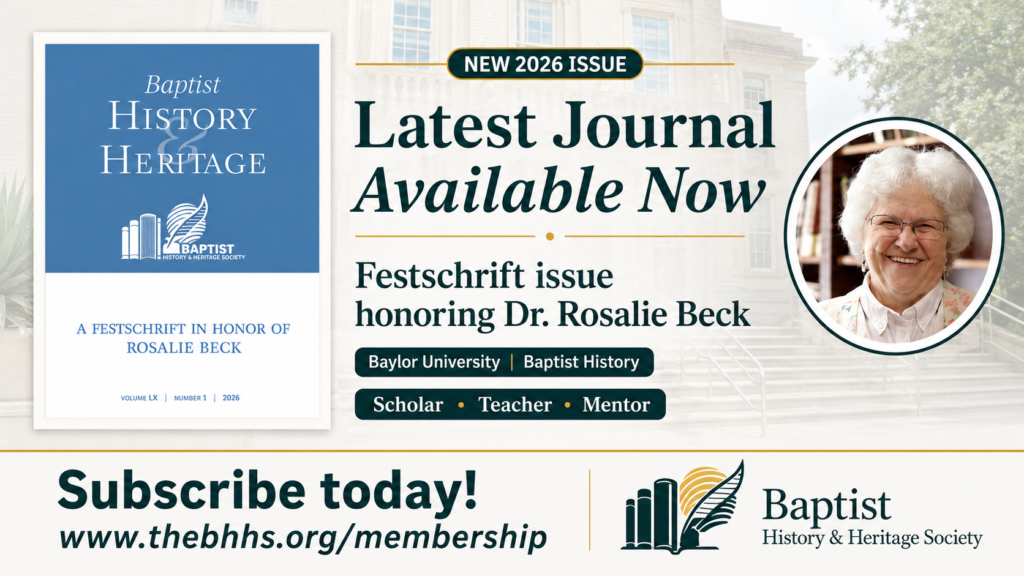
The following is the Executive Director’s note from the new festschrift issue of Baptist History & Heritage honoring Dr. Rosalie Beck. Become a member to receive your copy of this issue as part of your yearlong subscription.
By Dr. Aaron Douglas Weaver
For four decades, Dr. Rosalie Beck helped students, scholars, pastors, and church leaders learn to love God with their minds. That phrase appears more than once in the tributes gathered in this issue, and it is a fitting description of her life’s work. Dr. Beck has taught Christian history and Baptist history not as a collection of names and dates, but as a living story—one that shapes communities, forms convictions, challenges assumptions, and calls each generation to faithful remembrance.
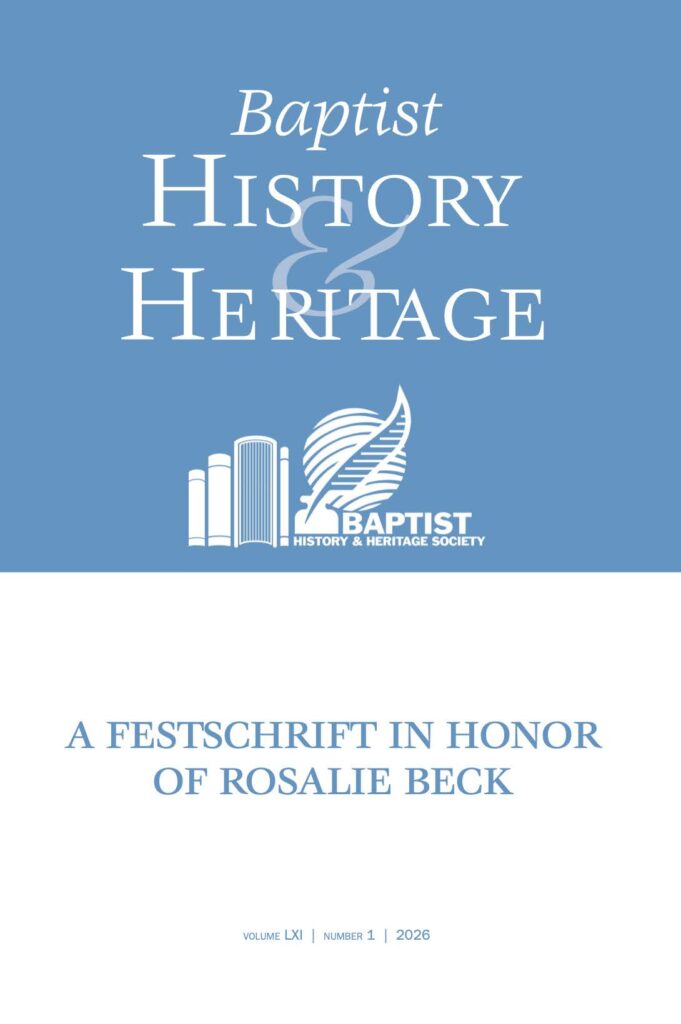
This issue of Baptist History & Heritage is presented as a Festschrift in honor of Rosalie Beck: scholar, teacher, mentor, colleague, church-woman, and friend. It is a joy for the Baptist History & Heritage Society to dedicate this volume to one whose own life and work so closely embody the mission of our Society.
Dr. Beck’s story is itself a Baptist story. After earning a degree in biology from the University of California at San Diego, she pursued theological study at Southwestern Baptist Theological Seminary and then doctoral work in religion at Baylor University, concentrating in church history. In 1984, she completed her Ph.D. and became the first woman hired as a faculty member in Baylor’s Department of Religion. That milestone mattered. It mattered for Baylor. It mattered for Baptist higher education. And it mattered for generations of students who needed to see that women belonged not only in the study of Christian history but also in the teaching, writing, interpretation, and preservation of it.
Her career at Baylor stretched across thirty-five years. In the class-room, she taught Baptist History, Christian Missions, Christian History, Women in Christian History, Women in American Religion, Baptist Doctrines, the Radical Reformation, American Christianity, and more.
In those courses, Rosalie introduced students to saints and dissenters, missionaries and reformers, preachers and teachers, women whose names had too often been neglected, and Baptists whose stories still speak to the present. She helped students see that history is not merely something behind us. It is part of the ground beneath us.
Those who know Dr. Beck know that her teaching has never been confined to the classroom. Even in retirement, she has continued to lead, teach, and serve through Baylor’s Lifelong Learning program and through the life of Seventh and James Baptist Church in Waco, where she has been a faithful member for nearly fifty years. Her love for Baptist history has always been connected to her love for the church. She has shown, in her own life, that scholarship and congregational faithfulness need not be separate callings.
Rosalie has also been deeply connected to the work of the Baptist History & Heritage Society. She has served the Society as president, contributed to and reviewed for this journal, presented scholarship through our gatherings, and helped preserve and interpret the Baptist story with care. Her publications in Baptist History & Heritage and elsewhere have strengthened Baptist scholarship, especially in the areas of women’s history, missions, religious liberty, and Baptist identity. Her service to the Texas Baptist Historical Society, the National Association of Baptist Professors of Religion, the Baptist World Alliance’s Commission on Baptist Heritage and Identity, and other scholarly organizations reflects the breadth of her commitment to Baptist history in local, national, and global perspective.
While I did not have the opportunity to take a class from Dr. Beck while a Baylor student, my wife, Alexis Cooper Weaver, did—and her 8 a.m. undergraduate course with Dr. Beck made a major impact. I would like to make a point of personal privilege to share Alexis’ memories from the class:
Rosalie Beck was my professor for Introduction to the Old Testament at 8 a.m. on Mondays, Wednesdays and Fridays during the fall of my freshman year in 2000. As someone raised by two unequivo-cal Baptist lay leaders, I came into that class with deep confidence in the Baptist principles I had been taught—soul freedom, religious freedom, church freedom, and, of course, Bible freedom. I had learned a great deal through my local church, and I do not think I was unique among my classmates in believing that we already knew the Bible fairly well!
What Dr. Beck taught me, however, was the importance of critical thinking and careful analysis when it came to Scripture. In particular, she helped me and others understand that the Old Testament is both a faithful representation of the experience of the people of God and a text that must be read with attention to story, narrative, creativity and context. She reiterated for everyone in the Tidwell classroom that it is not a science textbook, and that faithful interpre-tation requires serious engagement with the world behind the text and the literary forms within it. The context of Scripture mattered.
Rosalie did all of this at a formative moment in my faith. The idea of egalitarianism and the emphasis on Galatians 3:28 still felt relatively new to me, and there were only a handful of Baptist women pastors, especially senior pastors, visible to many of us at that time. Part of what Dr. Beck did for me was to solidify not only the importance of each of us being equipped to study and analyze Scripture, regardless of our position in life, training or credentials, but specifically the importance of being able to do that as a woman.
So I learned from Dr. Beck not only the nuances of the two creation stories and how they can both be true without being factual in a modern scientific sense, but also about the women leaders of the Old Testament. She was the first person to spend real time on Deborah’s role, to introduce me to Huldah, Zipporah and Puah, and to dive deeply into Miriam. I probably would not have named my oldest daughter Miriam were it not for Dr. Beck’s influence, because I might have missed Miriam’s prophetic role rather than knowing her only as the sister of Moses. Dr. Beck introduced me to women in the Old Testament beyond Esther and Naomi, who were probably the only women from the Old Testament I had encountered in meaning-ful ways through church and Sunday school. Under her teaching, women emerged as central characters with their own stories, not as accessories or ancillary figures in Scripture.
Twenty-six years later, in my professional life, I am not an academic, a religious scholar or an ordained minister. I work on policy issues around poverty and disability, and I serve my community as a city council member. If you looked only at my job and life on paper, there would be little reason to expect that I could speak meaningfully about stories of faith in the Old Testament. Yet while I was in Dr. Beck’s classroom to learn the foundations—and while she said clearly and repeatedly that this was not Sunday school, not church and not a theology class—the rigor with which we studied the Old Testament informed and deepened my faith, my calling and my commitment to the freedom each of us has as followers of Christ to read Scripture, as well as the responsibility we have to understand it as a witness to God’s relationship with God’s people.
I feel deeply blessed that such a foundational introductory course helped begin my adult life and college career, and that I had a profes-sor and mentor like Dr. Beck. She showed, rather than merely told, what it meant to be a smart, capable, independent woman and a faithful Baptist at a time when we as Baptists were still struggling to articulate that consistently. Dr. Beck was a remarkable role model in that way, and her influence has remained with me ever since.
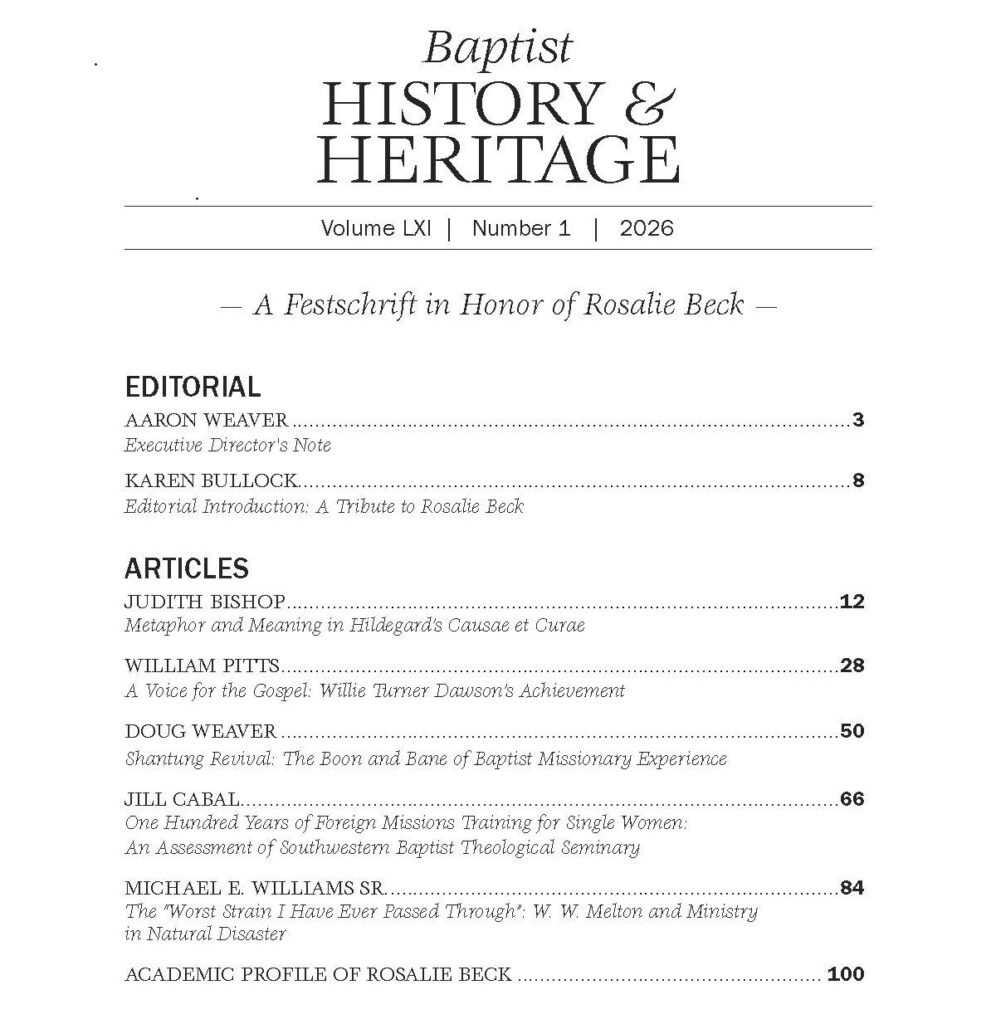
I am grateful to Dr. Karen Bullock for serving as guest editor of this terrific issue. Dr. Bullock has delivered a collection of articles that do more than honor an individual scholar. They remind us what Baptist history can be at its best: careful, generous, critical, faithful, and expan-sive. They recover women’s voices. They attend to congregational life. They explore missions and ministry, theological formation and public witness. They show how one scholar’s vocation can ripple outward into students, colleagues, institutions, churches, and future research.
That is why this issue is such a fitting expression of the work of BHHS. Since 1938, the Baptist History & Heritage Society has helped Baptists discover, conserve, assess, and share their history. Our vision remains to bridge the worlds of the academy and the congregation—to bring scholars, clergy, students, laypeople, churches, and institutions together around the shared work of telling the Baptist story.
That bridge matters. Baptist history belongs in classrooms and archives, but it also belongs in Sunday School rooms, church libraries, small groups, pulpits, conference halls, and conversations around tables. It belongs to students asking new questions, pastors seeking context for ministry, congregations trying to understand their identity, and schol-ars committed to truth-telling. Dr. Rosalie Beck’s career has stood at precisely that intersection. She has been a scholar for the church and a teacher for the academy, and her example calls us to continue building that bridge with care.
In that spirit, BHHS continues to develop resources that make Baptist history accessible for congregations, students, and lifelong learners. The Baptist Story and its companion discussion guide invite readers to explore Baptist identity across more than four centuries. Our Baptist Identity Resources, available as free downloads in English and Spanish, introduce core Baptist convictions such as believer’s baptism, liberty of conscience, congregationalism, the priesthood of all believers, and a passion for the gospel.
Portraits of Courage: Stories of Baptist Heroes helps older children and youth encounter Baptists whose lives displayed conviction and courage. These resources are designed to serve churches, classrooms, families, and small groups who want to know the Baptist story more deeply.
As I reflect on Dr. Beck’s legacy, I am especially grateful for all who make the work of BHHS possible: our members, donors, congregational partners, institutional supporters, writers, editors, reviewers, conference participants, and friends. Every journal issue, annual conference, digital resource, and congregational study guide exists because people believe the Baptist story matters.
When you join or renew your BHHS membership—or invite a friend, colleague, church, or institution to become part of the Society—you help us share that story. When you make a gift, whether one-time or monthly, you help sustain the publication of Baptist History & Heritage, the development of new resources, and the gatherings that connect scholars and congregations.
You can make a special gift to the Baptist History & Heritage Society at www.thebhhs.org/give or join or renew your membership at www.thebhhs.org/membership. We also welcome new congregational partners and invite churches to learn more at www.thebhhs.org/partner. On behalf of the Baptist History & Heritage Society, thank you, Dr. Beck, for helping so many Baptists love God with their minds. Thank you for teaching us to remember carefully, to ask good questions, to recover neglected voices, and to tell the Baptist story with honesty and hope.
Aaron Weaver
Executive Director
Baptist History & Heritage Society | aweaver@thebhhs.org